THESE ARE ENTRIES TO A WASHINGTON POST COMPETITION IN THE STYLE SECTION, ASKING FOR A TWO-LINE RHYME WITH THE MOST ROMANTIC FIRST LINE, BUT THE LEAST ROMANTIC SECOND LINE:Ain't love wonderful?
My darling, my lover, my beautiful wife:
Marrying you screwed up my life.
I see your face when I am dreaming.
That's why I always wake up screaming.
Kind, intelligent, loving and hot;
This describes everything you are not.
Love may be beautiful, love may be bliss,
But I only slept with you 'cause I was pissed.
I thought that I could love no other --
That is until I met your brother.
Roses are red, violets are blue, sugar is sweet, and so are you.
But the roses are wilting, the violets are
dead, the sugar bowl's empty and so is your head.
I want to feel your sweet embrace;
But don't take that paper bag off your face.
I love your smile, your face, and your eye s --
Damn, I'm good at telling lies!
My love, you take my breath away.
What have you stepped in to smell this way?
My feelings for you no words can tell,
Except for maybe 'Go to hell.'
What inspired this amorous rhyme?
Two parts vodka, one part lime.
Thursday, September 20, 2007
From the Junk Email Bag
O.K. This was going to be my place for serious writing. Well, in case you haven't noticed, the well went dry long before it could even get primed. So, today I'm throwing all caution to the wind and giving you this, the email today I received from a long, nearly forgotten acquaintance who has kept me on her junk email-forwarding list.

Wednesday, September 19, 2007
Shock!
I've been reading about this a lot lately. See what you think.
The Shock Doctrine: Naomi Klein on the Rise of Disaster Capitalism
Read substantial excerpts here.
Click below to see The Shock Doctrine Short Film, a film by Alfonso Cuarón and Naomi Klein, directed by Jonás Cuarón:
See also Naomi Klein speaking:
Naomi Klein - The Shock Doctrine - Part 1 of 6
Naomi Klein - The Shock Doctrine - Part 2 of 6
Naomi Klein - The Shock Doctrine - Part 3 of 6
Naomi Klein - The Shock Doctrine - Part 4 of 6
Naomi Klein - The Shock Doctrine - Part 5 of 6
Naomi Klein - The Shock Doctrine - Part 6 of 6
The Shock Doctrine: Naomi Klein on the Rise of Disaster Capitalism
Economist Milton Friedman once said, "Only a crisis produces real change. When that crisis occurs, the actions that are taken depend on the ideas that are lying around." Naomi Klein examines some of what she considers the most dangerous ideas -- Friedmanite economics -- and exposes how catastrophic events are both extremely profitable to corporations and have also allowed governments to push through what she calls "disaster capitalism."
Read substantial excerpts here.
Click below to see The Shock Doctrine Short Film, a film by Alfonso Cuarón and Naomi Klein, directed by Jonás Cuarón:
See also Naomi Klein speaking:
Naomi Klein - The Shock Doctrine - Part 1 of 6
Naomi Klein - The Shock Doctrine - Part 2 of 6
Naomi Klein - The Shock Doctrine - Part 3 of 6
Naomi Klein - The Shock Doctrine - Part 4 of 6
Naomi Klein - The Shock Doctrine - Part 5 of 6
Naomi Klein - The Shock Doctrine - Part 6 of 6
Monday, September 10, 2007
La Cage Aux Folles
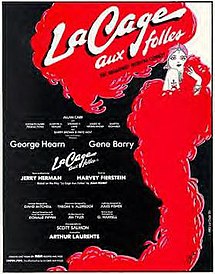 I saw the original movie when it first came out and have loved the story in its various renditions since (though I am still partial to the original). I've never seen the musical, but I wanted to commemorate it today for two reasons.
First is to celebrate the performance by high school students in Orlando, despite Bishop Howe's eleventh hour attempt to cancel the event after months of rehearsal and preparation. The arts community helped them find another theatre once they were prohibited from using school property. The result was a standing room only performance.
Second, I was talking to my mother about it today for some reason, and I discovered that the show had a special significance for her, as well. Years ago she started attending a dinner theater in the Chicago suburbs with a friend she had known from high school but with whom she had little contact in the intervening years after she married and had children and her friend remained single and worked in the city. I knew all about the season tickets they had together but, until today, I never knew how it was that they started going together.
It turns out that my mother's friend previously had the tickets with another woman until one year when the series included La Cage Aux Folles. The other woman was angry and upset over its inclusion and the fact that my mother's friend decided to go alone to see it anyway. So suddenly my mother's friend had an extra ticket for the rest of the season, and she offered it to my mother.
What is remarkable about this story (to me, at least) was that this was what rekindled their friendship and gave my mother the means to attend the theater with some regularity long after she was unable to go to the theater or concerts in the city or anywhere on her own -- something she enjoyed very much until her friend died last year of breast cancer. In hindsight it seems like kind of a sign pointing towards what was later initially very difficult for my mother -- accepting her niece's relationship with another woman and having them visit her and stay in her home. While things were fine once they all met, she had a really rough time beforehand, spending much time on the phone with me trying to work through her conflicted feelings. It's nice to think now in hindsight that maybe the dawning of her tolerance and understanding may have come from La Cage many years before. In any event, it brought her back to her old high school friend and brought them several years of renewed friendship and lovely theater afternoons.
Saturday, September 8, 2007
The Scent of God
Although I tried to stretch it out the last few days, I have just finished reading The Scent of God by Beryl Singleton Bissell. I think she would appreciate the fact that, just as I put the book down, I was suddenly struck with the sweet-strong smell of fresh brownies wafting upstairs from the kitchen, where my daughter had been baking.
I will have to spend some more time letting this extraordinary book sink in awhile. It is a book full of touch, smell, sight, and sound, infused with spirit.
I will have to spend some more time letting this extraordinary book sink in awhile. It is a book full of touch, smell, sight, and sound, infused with spirit.
When passions get thrown beneath a train
Somehow my mind and heart are drawn to radically different thoughts and ideas, often at the same time. I'm currently experiencing some difficulties that seem to call for both dispassion and perhaps even separation from people and things I hold very dear, putting self and self-interest aside [see "East and West" below], and, at the same time, speaking out of my deepest passions and asserting my true self. Paradoxically, both seem required.
Here is what struck me deeply this week from the speaking side:
These words seem to cry out what the dignity of every human being requires, the "I" that will not be thrown to the rubbish, will not be dismissed and devalued as something less than the "I"'s or "We" in power. The problem is how to speak with dignity and pride, not in one's self but in one's humanity, created and loved by God, with the spark of his divine image, without inflating one's self into a monstrous, fiery, steam-driven engine of power that seeks to dash others beneath the rails.
Update: Read an excellent essay today on control and letting go by Tandaina at Snow on Roses.
Here is what struck me deeply this week from the speaking side:
I do not know how or where I learned it, but I had learned not to say what I really thought or truly believed or most desired. I internalized Tolstoy’s Anna Karenina: women who express their deepest passions get run over by trains. The way of safety is to say what others want you to say, to repeat the words of those who hold power. And if you do that well enough you might gain a modicum of control over your own life.From Strength for the Journey: A Pilgrimage of Faith in Community by Diana Butler Bass (Jossey-Bass, 2002) (From "Unlearning not to speak" at Speaking to the Soul.)* * * *Throughout church history, however, the words of women and children, of the poor, the sick, and enslaved, have often been silenced by words of the wealthy, learned, and powerful. And if no one listens, you learn not to speak. When such voices are lost, the Word is diminished. I could express few genuine words. I needed to find my voice. Poet Marge Piercy writes in “Unlearning Not to Speak”:
She must learn again to speak
starting with I
starting with We
starting as an infant does
with her own true hunger
and pleasure
and rage.
These words seem to cry out what the dignity of every human being requires, the "I" that will not be thrown to the rubbish, will not be dismissed and devalued as something less than the "I"'s or "We" in power. The problem is how to speak with dignity and pride, not in one's self but in one's humanity, created and loved by God, with the spark of his divine image, without inflating one's self into a monstrous, fiery, steam-driven engine of power that seeks to dash others beneath the rails.
Update: Read an excellent essay today on control and letting go by Tandaina at Snow on Roses.
East and West
I have no parents
From Sunday's Lectionary reading, Luke 14:25-32:
I make the heavens and earth my parentsI have no home
I make awareness my homeI have no life or death
I make honesty my divine powerI have no friends
I make my mind my friendI have no enemy
I make carelessness my enemyI have no armor
I make benevolence my armorI have no castle
I make immovable-mind my castleI have no sword
I make absence of self my sword.14th c. Japanese samurai (quoted by Joseph Goldstein in Insight Meditation: The Practice of Freedom at p. 13, Shambhala, Boston 2003).
From Sunday's Lectionary reading, Luke 14:25-32:
25 Now great crowds accompanied him, and he turned and said to them, 26 “If anyone comes to me and does not hate his own father and mother and wife and children and brothers and sisters, yes, and even his own life, he cannot be my disciple. 27 Whoever does not bear his own cross and come after me cannot be my disciple. 28 For which of you, desiring to build a tower, does not first sit down and count the cost, whether he has enough to complete it? 29 Otherwise, when he has laid a foundation and is not able to finish, all who see it begin to mock him, 30 saying, ‘This man began to build and was not able to finish.’ 31 Or what king, going out to encounter another king in war, will not sit down first and deliberate whether he is able with ten thousand to meet him who comes against him with twenty thousand? 32 And if not, while the other is yet a great way off, he sends a delegation and asks for terms of peace. 33 So therefore, any one of you who does not renounce all that he has cannot be my disciple.ESV Bible
Thursday, August 23, 2007
When There is Nowhere Else to Speak
Sr. Joan Chittister, on meeting with Cardinal Eduardo Pironio, Argentinian spokesperson for the poor:
His deep dark eyes were sad. There was no doubt he understood. But then he dropped his shoulders, clasped his hands between his knees and began to shake his head slowly from side to side. “Jhoan, Jhoan, Jhoan,” he said. “What you say is true but you must never say it any place but here. For the sake of the church,” he said, “you must never say these things in public. Only here”---he gestured around the room—“only here behind closed doors, between ourselves.”Excerpt from Called To Question: A Spiritual Memoir in this week's "Ideas in Passing" at Benetvision.
I understood his concerns. I know as well as he did that unity is a fragile strength. But I also knew what he didn’t. For the sake of the church, what women wanted had to be said in public because there was nowhere else for a woman to say it.
Saturday, August 18, 2007
St. Francis and the Sow
The budstands for all things,even those things that don't flower,for everything flowers, from within, of self-blessing;though sometimes it is necessaryto reteach a thing its loveliness,to put a hand on its browof the flowerand retell it in words and in touchit is lovelyuntil it flowers again from within, of self-blessing;as St. Francisput his hand on the creased foreheadof the sow, and told her in words and in touchblessings of earth on the sow, and the sowbegan remembering all down her thick length,from the earthen snout all the waythrough the fodder and slops to the spiritual curl of the tail,from the hard spininess spiked out from the spinedown through the great broken heartto the blue milken dreaminess spurting and shudderingfrom the fourteen teats into the fourteen mouths sucking and blowing beneath them:the long, perfect loveliness of sow. - Galway Kinnell
Audio at http://imaginenature.amnh.org/st_francis/stfrancis.html
Inspired by reading Insight Meditation: The Practice of Freedom by Joseph Goldstein.
Wednesday, August 15, 2007
Do Nothing or Change (or keep mixing up the game)
Seeking spiritual wisdom and insight can sometimes lead to odd results. Ann Fontaine recently wrote a piece called "Do Nothing to Change Your Life" over at the Episcopal Café based on a book recommended by the Archbishop of York.
Meanwhile, my email newsletter from Benetvision contains an article by Sr. Joan Chittister that asks "Why Can't I Change?"
Needless to say, there's food for thought in both pieces. But I especially liked the humor and wisdom in this story Sr. Chittister had to tell:
Do read the whole piece and Ann's as well.
Meanwhile, my email newsletter from Benetvision contains an article by Sr. Joan Chittister that asks "Why Can't I Change?"
Needless to say, there's food for thought in both pieces. But I especially liked the humor and wisdom in this story Sr. Chittister had to tell:
Then we come face-to-face with the flat face of the soul, that part of us that grows only in increments and insights, never by trampolining from one self to another. This kind of change only comes slowly, only from one struggle to another, only barely.
The spiritual masters, given to whole lifetimes of confrontation with the self, knew it all too well.
Once upon a time, Abba Poemen said of Abba John that Abba John had prayed to God to take his passions away from him so that he might become free from care.
“And, in fact,” Abba John reported to him, “I now find myself in total peace, without an enemy.”
But Abba Poemen said to him, “Really? Well, in that case, go and beg God to stir up warfare within you again, for it is by warfare that the soul makes progress.”
And after that, when warfare came, Abba John no longer prayed that it might be taken away. Now he simply prayed, “Lord, give me the strength for the fight.”
- from Welcome to the Wisdom of the World
By Joan Chittister
Do read the whole piece and Ann's as well.
Subscribe to:
Posts (Atom)